

BANGLADESH: Ever so vulnerable to storms, floods and sea level rises
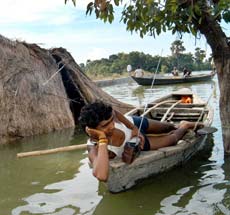
DHAKA, 31 December 2009 (IRIN) – Low-lying Bangladesh with its 230 rivers and dense population of over 150 million has long been prone to flooding, soil erosion and saltwater intrusion, but climate change could aggravate the situation, experts and government officials warn.
In a report entitled A Global Report: Reducing Disaster Risk: A Challenge for Development, the UN Development Programme (UNDP) has identified Bangladesh as the country most vulnerable to tropical cyclones and sixth most vulnerable to floods.
According to data from the government’s Centre for Environmental and Geographic Information Systems (CEGIS), two-thirds of the country is only five metres above sea level, rendering it particularly vulnerable to sea level rises and tidal waves.
Melting Himalayan glaciers and an encroaching Bay of Bengal in the south, further increase the risk of flooding, experts say.
The fourth assessment report by the Intergovernmental Panel on Climate Change (IPCC) predicts that an increase in monsoon rainfall across South East Asia and melting Himalayan glaciers will result in increased water volumes in rivers that flow into Bangladesh from India, Nepal, Bhutan and China.
Damaged embankments
Low-lying southern coastal regions are the most vulnerable, despite being protected by a 5,107km-long network of flood embankments.
Almost half of this embankment network was damaged by recent cyclones (Sidr and Aila), leaving the whole region vulnerable to the tides, according to Bangladesh’s Comprehensive Disaster Management Programme.
High population density means many Bangladeshis are forced to live on and cultivate flood-prone land.
“Our fields are dying because of the salty water. It is impossible to grow anything in them any more,” lamented Abbasuddin Mollah, a 60-year-old farmer from the coastal district of Bagerhat.
“Without the dykes to protect us, the tides rush in twice daily and swamp the croplands,” he told IRIN.
“This is the sort of effect rising sea levels will have on Bangladesh. We are fighting climate change on the front line,” said Ainun Nishat, one of the country’s leading environmentalists.
Government response
But according to Hasan Mahmud, state minister of environment and forestry, the government is working to address the issue.
A massive river dredging project at an estimated cost of US$2 billion has already been undertaken by the government in order to conserve water, increase the capacity of the rivers, and channel more fresh water into them to decrease their salinity.
“There are four indicators to measure the extent of damage that a country will have to face due to global climate change: the direct harmful impact of climate change; increasing natural disasters; the number of people facing these dangers; and the measures already undertaken by that country to reduce the negative impacts of climate change. Bangladesh is eligible on all counts,” Mahmud said.
The 2009 Bangladesh Climate Change Strategy and Action Plan published by the Ministry of Environment predicts that within the next 50 years, over 20 million people could be displaced and become “climate change refugees”, if sea and salinity levels rise.
The Plan recommends combating the effects of climate change by focusing on social security, disaster management, infrastructure development, research and knowledge management, low carbon development options and institutional capacity development.
Meanwhile experts warn of the increasing frequency and/or intensity of tropical storms in the Bay of Bengal.
“For Bangladesh, effects of climate change are no longer a future threat. It is already a reality for us,” State Minister Hasan Mahmud said.
20 Million at Risk from Bangladesh Floods
New research shows a bleak future for Bangladesh, claiming up to 20 million people are at risk from rising sea levels and monsoon floods.

The research by the Centre for Environmental and Geographic Information Services in Bangladesh predicts that sea water could reach far inland, as many rivers are surrounded by low lying flood plains. As well as displacing those living in these areas, it would make it hard to cultivate such basic foods as rice.
The research comes as the Bangladesh Government appeals for £3 billion in aid over the next five years to combat climate change in the region. The study suggest that a surprisingly small amount of land will be permanently lost to rising sea levels, but perhaps the bigger threat is repeated Bangladesh floods every monsoon season, especially in the south west region.
A senior scientist on the study claims sea water could cause havoc for rice production in Bangladesh’s poorest regions.
“These are very poor people, and vulnerable. For four months they’ll have nowhere to work, So people will migrate to the cities for jobs, because of the uncomfortable situation with sea level rise. We are talking about 20 million people.”
According to Bangladesh monitoring stations, there has been an average of 5mm sea level rise per year for the past 30 years. Nearly half of the rice produced in Bangladesh is so call “monsoon” rice, much of which is grown in the areas most vulnerable to Bangladesh floods.
Bangladesh has been listed as one of the countries vulnerable to “extreme risk” from climate change over the next 100 years.
Here is a video from BBC News on possible solutions to Bangladesh floods, and how the people could adapt to climate change. Britain’s Department for International Development is sponsoring farmers with new ideas such as gardens that float, and cultivating crabs and ducks instead of crops and chickens.

20 Million at Risk from Bangladesh Floods
New research shows a bleak future for Bangladesh, claiming up to 20 million people are at risk from rising sea levels and monsoon floods.
The research by the Centre for Environmental and Geographic Information Services in Bangladesh predicts that sea water could reach far inland, as many rivers are surrounded by low lying flood plains. As well as displacing those living in these areas, it would make it hard to cultivate such basic foods as rice.
The research comes as the Bangladesh Government appeals for £3 billion in aid over the next five years to combat climate change in the region. The study suggest that a surprisingly small amount of land will be permanently lost to rising sea levels, but perhaps the bigger threat is repeated Bangladesh floods every monsoon season, especially in the south west region.
A senior scientist on the study claims sea water could cause havoc for rice production in Bangladesh’s poorest regions.
“These are very poor people, and vulnerable. For four months they’ll have nowhere to work, So people will migrate to the cities for jobs, because of the uncomfortable situation with sea level rise. We are talking about 20 million people.”
According to Bangladesh monitoring stations, there has been an average of 5mm sea level rise per year for the past 30 years. Nearly half of the rice produced in Bangladesh is so call “monsoon” rice, much of which is grown in the areas most vulnerable to Bangladesh floods.
Bangladesh has been listed as one of the countries vulnerable to “extreme risk” from climate change over the next 100 years.
Here is a video from BBC News on possible solutions to Bangladesh floods, and how the people could adapt to climate change. Britain’s Department for International Development is sponsoring farmers with new ideas such as gardens that float, and cultivating crabs and ducks instead of crops and chickens.
3 responses to “20 Million at Risk from Bangladesh Floods”
- The effects of climate change are evident in this region, where they have done little to cause it compared to most countries.
-
How to Solve World Hunger | Skip To The End October 13th, 2009 at 11:21
It hasn’t gone away. Whether it’s the Kenya drought crisis in East Africa, or floods in Bangladesh, A billion people still living without reliable sources of water and food. So much suffering is
-
MedEco Travel November 24th, 2009 at 15:09
I believe these regions can be helped to develop their economies and create livelihoods by responsible eco tourism.
MedEco Travels is a specialist travel and tourism firm set up with an emphasis on eco and responsible travelling. One of our aims is to promote livelihoods in the developing world though commerce and tourism.
To achieve this aim we have set up tours of Bangladesh with wellknown UK based personalities as tour leads. We are encouraging overseas Bangladeshis to rediscover, to explore, and to learn about their own heritage; promote the natural beauty and culture of the land to non Bangladeshis; and support the growth of trade and commerce with in local communities in Bangladesh creating self sufficient individuals and communities.
Go and meet the people there, visit the longest beach, largest mangrove forest, Royal Bengal Tigers and help promote Bangladesh as a tourist destination before major parts of it are severely affected by climate change.
Arfar Choudhury
MedEco Travels
info@medecotravel.com
Welfare Wellbeing Responsibility
-
Climate Change Debate – What You Should Know
Posted on October 30th, 2009 Global Changes 1 commentThe climate change debate is really heating up ahead of the Copenhagen Climate Change Conference in December. But it seems that more and more people are taking a sceptical view on climate change.

I think a lot of things are to blame for this. Mostly it’s down to politicians who have been warning us about climate change for years but have in reality done nothing about it. It’s all well and good trying to spread awareness of the threats of climate change that we all face, but everyone is aware of it now. Continuing to spread awareness without actually doing anything about it is just making people fed up and leading to more people choosing to falsely believe that global warming is just a natural cycle or that it has not been impacted by human emissions.
Of course sceptical opinion its being helped by oil companies spreading propaganda and funding fake scientists to dismiss the greenhouse effect, picking small inaccurate truths and manipulating them to use as “evidence global warming is not man made”. Their argument is helped further when governments exaggerate predictions of climate change to make people take it seriously. Both of these schemes are wrong and should be ended now.
So forget what you have been told, here are the facts behind climate change. Read them and make up your own mind.
- The world is warming. Average global temperatures have increased by 0.74C over the past 100 years and by 0.6C in the 100 years before that.
- There is a parallel trend of rising greenhouse gas levels in the atmosphere with rising temperatures. CO2 levels in the atmosphere have risen from 280 parts per million (ppm) in pre industrial times to 387ppm today. Methane levels have also risen from 700 parts per billion to 1,745 parts per billion. Today’s levels of these greenhouse gases are the highest for at least 650,000 years.
- The worlds climate can vary naturally. The Earth’s orbit, changes in the intensity of the Sun, volcanic eruptions, atmospheric pollution and natural variations such as El Nino can all impact atmospheric temperatures.
- Evidence of the past climate shows that rising greenhouse gas levels have been followed by warming. In the past decade, scientists have also established that it is impossible to account for recent observed changes in global temperatures unless human activities have had an impact. Computer models of the Earth’s climate agree that natural variation can explain only a part of recent warming. Only if man made greenhouse gases are included do the models replicate what has actually happened.
- The warmest year on record was 1998. This was in part due to a strong El Nino which has a heating effect. Since then temperatures have stabilised but at a very high level. The 10 warmest years on record have all occurred after 1997.
- Natural climate variations mean that there will be periods of temperature stability even when the overall temperature trend rises. The the stabilising temperatures of the last decade are not a sign that global warming has stopped.A study led by Jeff Knight and Peter Stott, of the Met Office, found that such hiatuses occur relatively often during periods of warming, and aren’t inconsistent with the upward trend.
- Arctic sea ice is in long term decline. In 2007 a record low of 39.2% less ice than the 1979-2001 average was recorded.There is considerable natural variation in ice extent from year to year, but the overall trend is towards shrinkage. Models generally predict that the Arctic will be ice-free in the summer by 2060 to 2080, though some recent estimates have suggested this could happen more quickly.
When discussing climate change please remember that the discussion on whether man made global warming is happening or not has ended. It’s not for us the public to decide whether we believe scientific proof or not, unfortunately our opinion has no impact on the truth. What we can impact is what we do to prevent it. Now we must focus our efforts on working together to prevent dangerous warming of or climate and secure a safe sustainable future.
-
Climate Change: How Long Have We Known? Part 2
Posted on October 7th, 2009 Global Changes 2 commentsHere is part two of our article on the history of climate change.
BBC News has just posted an interesting article detailing a “History Of Climate Change” which covers some more milestones in the climate change story.
In 1824 a French physicist is the first person to discover the “greenhouse effect” that is so publicly spoken of today.
It wasn’t until 1896 when a Swedish chemist concluded that the coal burning of the industrial age would contribute to the greenhouse effect, predicting his research would be useful for future generations. His predictions of temperature increase in-line with CO2 emissions were not far off those of today’s climate models.
In 1938 the first direct evidence of global warming was recorded, as temperatures we found to have increased over the previous century in line with CO2 emissions. At the time it was widely dismissed that emissions caused the warming.
In the 1950’s the US developed new world leading equipment in the field and began researching the climate. Researches not only concluded that CO2 concentrations were rising, but that a doubling of CO2 concentrations would increase temperatures by 3-4 degrees Centigrade. They also discovered that seawater would not absorb the additional CO2 in the atmosphere as many had predicted. US oceanographer Roger Revelle then claims “Human beings are now carrying out a large scale geophysical experiment…”

Little is done until the 1970’s when the UN hosts its first Environment conference, but climate change doesn’t appear on the agenda. Finally in 1975 a US scientist thrusts the term “global warming” into the public domain, making it the title of his scientific paper. A further 13 years latter in 1988 the Intergovernmental Panel on Climate Change (IPCC) is formed to collate evidence and establish the threat of climate change. 2 years later the IPCC publish their first report, concluding that global warming is happening, and that it is a direct result of man made fossil fuel emissions.
2009 and over 100 years after the discovery that increasing CO2 levels in the atmosphere causes our climate to warm, still we have done nothing to stop it. Still people argue whether or not it actually exists. Still politicians wont except that we have built the world on unsustainable infrastructure that will soon be over-populated, with dwindling resources and a dangerous warming climate.
Posted on October 2nd, 2009 Global Changes 2 commentsClimate change has been nearly continuously in the press over the past few years, and is likely to remain in the headlines for the years to come. But it hasn’t always been that way.

The theory behind the global warming causing climate change first started to hit the press in the 1960’s. Using Google’s news search tool, you can actually look for the stories that are published online by date yourself. Here are some highlights:
The Virgin Island Daily News – Feb 18th 1970
In a small section on page 7 titled “Other Views” we have a brief mention of global warming. It states that scientists are warning that pollution could alter the earth’s climate. However it claims that scientists are split, half believing it will cause a global warming effect, and half believing it will lead to a new ice age. Theories being that gasses would either reflect the suns radiation causing cooling, or trap it causing warming.
 So until the scientists come up with new ideas, we can look forward to living in a global hothouse or freezing to death. In the meantime, we had all better get busy and do something effective about pollution.
The Blade – June 12th 1979
This article reports that Carbon Dioxide levels are rising in the atmosphere, and that it could lead to a global warming trend. It already mentions the “green house effect” and the fear that climate change could melt the polar ice caps. It claims Carbon Dioxide levels in the atmosphere were 335 ppm in 1978 and predicts that levels could reach 600 ppm between 2025 and 2075. That, they predicted, would cause 2.7 to 5.4 degrees Fahrenheit of warming (that’s 1.5 to 3 degrees C). CO2 levels are now thought to be 385 ppm
Interestingly however, they don’t seem that worried about the polar ice caps.
But it would take perhaps 1,000 years of unusually warm climate to cause substantial melting of the polar ice capsHowever a New York Times article from the same year reports that climatologists were warning that newborns could live to a time when the north pole will have melted due to climate change.
New York Times – October 19th 1981
A whole article, with the title “EVIDENCE IS FOUND OF WARMING TREND”. Research showed evidence for the first time that “carbon dioxide pollution is causing a potentially dangerous warming of the earth’s climate”. This story was covered in most newspapers.
The Courier – July 20 1986
“Global Warming trend could cost billions”. The title of an article which is more informative and precise than most of the crap you can read in nowadays press, showing concerns of food and water shortages and crop degradation, as well as predicting that climate change could cost “as much as $200 billion to adjust to irrigation patterns alone”.
So it seems that we have not only known of the cause and effects of climate change for nearly 30 years, we have done nothing about it. Most of these predictions have been fairly accurate, so surely appropriate action could easily have been decided upon and taken. Apparently not. In-fact, despite 30 years of proof and research, we are still arguing about whether it exists. With statistics like that, climate change seems inevitable, unless we get smart and get smart now.
In part 2 see the history of climate change in scientific discovery.
-
Kenya Drought: East Africa In Crisis
Posted on September 29th, 2009 Our Changing Climate 4 commentsHeard about it? Probably not. East Africa is climate change ground zero. If it was a richer developed country it would be all over the news. This is the real human impact of climate change the western media doesn’t show you.

Kenya has a delicate climate. Already so hot, that further increase in temperature can throw whole ecosystems out of balance. An epic drought has been cast upon countries like Kenya, Ethiopia, Somalia and Uganda. This in turn has caused a further life threatening humanitarian crisis. The severe drought, that now occurs year on year, has lead to severe shortages of not only water, but food and livestock too. It is estimated that 23 Million people are threatened by the crisis.
Kenya drought has been especially damaging. In some regions lack of rain has destroyed whole harvests. Many people depending on livestock have also struggled to keep them alive with no water to feed them. Kenya drought and the food shortage has forced the price of food beyond that of what most families can afford.
Kadra Good, Harshin, EthiopiaIf the drought continues we will not be able to raise any animals as there will be no pasture or water. So we will have no money to send our children to school. If we can’t get money from raising animals we don’t know what else we can do.UK based Charity Oxfam have launched and emergency appeal for £9.5 million in donations to help those suffering from Kenya drought and the food crisis in East Africa. The charity have made themselves synonymous with helping those impacted by climate change throughout this year with there “Here and Now” campaign, aimed to highlight the fact that poorer countries are already suffering at the hands of climate change and the need to act here and now.
-
Climate Change Aid: Copenhagen Calling
Posted on September 11th, 2009 Global Changes 6 commentsHere is a key issue that will cause big discussion at the Climate Change Summit in Copenhagen this December. Will the EU and other developed nations fund poor countries to help protect themselves from the impacts of climate change?
 Money. You would think we would have run out of it by now after the dreadful year we have had. But the truth is the developed world has lots of it. In most cases it’s because of one thing. Fuel. Fossil fuels to be exact. The economic powerhouses of the last century became so because of their discovery, cultivation, use and export of oil, gas and coal.
Towards the end of the century it became apparent that the earth was warming. Gas emitted from burning these fuels, such as carbon dioxide, have a “greenhouse effect” on our atmosphere, trapping heat and causing “global warming”. The Industrial age, fueled by these fossil fuels, developed wealthy nations in North America and Western Europe. A new civilisation was born and a new quality of life reigned, whilst poorer third world countries were left in the dark.
Only over the past decades has poorer nations began to catch up with the developed world. These developing nations relying as their developed counterparts did on fossil fuels to power their industry, and build their future. But the last decade has seen them face new challenges.
A warming world is a more dangerous world. Climate change has become a reality in the hotter parts of the world. These already warm climates are home mostly to these developing nations. As climate change is a result of emissions from the use of fossil fuels, that surely means the nations that got rich from using them are responsible for the outcome. It is therefor unfortunate and unjust that as climate change begins to effect our world, the first countries to suffer are the poorer developing nations that have not reaped the benefits of the fuels that caused it.
 2009 sets the stage for the most important meeting on climate change in history. Already an estimated 300,000 people are loosing there lives every year in climate changes related disasters, and nearly 300 Million are directly effected. 20 Million people are threatened yearly by Bangladesh floods alone. The Climate Change Summit in Copenhagen must reach a decision on how to deal with the issue of the impact of climate change on poorer nations.
The UN estimates that poor nations will need around $100 Billion (£60 Billion) to adapt to climate change. This should come from developed nations. 40% of the money is aimed to come from a carbon trading scheme that is supposed to emerge from the summit.
The European Commission believes $2 Billion – $15 Billion each year is a fair share for the EU to give to poorer nations. The commission believes that “industrialised nations and economically more advanced developing countries” will have to provide $22-50bn per year.
Will these countries step up and put the lives of other people before their own economies? After all the USA managed to fund their own banks with over $1 trillion in the last year, more than enough to end world hunger.
In all failure to reach a fair deal for aid to developing nations hit by climate change would be a sad day for humanity. For too long politicians have prioritised their economies over human lives and well, just about everything. It’s time for developed nations to accept their responsibility for climate change, and remember that people come first.
 নষ্ট ভ্রষ্ট আমরা বাঙ্গালী জাতি
