>
Why Bengali needs separation from Pakistan? In August 1947, the Partition of India gave birth to two new states named Pakistan and India. Areas containing the Muslim-majority became Pakistan while areas with Hindu majority states became India. The new nation of Pakistan included two geographically and culturally separate areas in the east and the west of India. The western zone was popularly (and for a period of time, also officially) termed West Pakistan and the eastern zone (modern-day Bangladesh) was initially termed East Bengal and later, East Pakistan. It was widely perceived that West Pakistan dominated politically and exploited the East economically, leading to many grievances.
On the 25 March 1971, rising political discontent and cultural nationalism in East Pakistan was met by brutal[8] suppressive force from the ruling elite of the West Pakistan establishment in what came to be termed Operation Searchlight.
The violent crackdown by West Pakistan forces led to East Pakistan declaring its independence as the state of Bangladesh and to the start of civil war. The war led to a sea of refugees (estimated at the time to be about 10 million) flooding into the eastern provinces of India Facing a mounting humanitarian and economic crisis, India started actively aiding and organizing the Bangladeshi resistance army known as the Mukti Bahini.
East Pakistani grievances Economic exploitation
West Pakistan (consisting of four provinces: Punjab, Sindh, Balochistan and North-West Frontier Province) dominated the divided country politically and received more money from the common budget than the more populous East.
Year Spending on West Pakistan (in crore Rupees) Spending on East Pakistan (in crore Rupees) Amount spent on East as percentage of West
1950–55 1,129 524 46.4
1955–60 1,655 524 31.7
1960–65 3,355 1,404 41.8
1965–70 5,195 2,141 41.2
Total 11,334 4,593 40.5
Source: Reports of the Advisory Panels for the Fourth Five Year Plan 1970-75, Vol. I, published by the planning commission of Pakistan (Quick reference: crore = 107, or 10 million)
Political differences
Although East Pakistan accounted for a majority of the country’s population (14), political power remained firmly in the hands of West Pakistanis, specifically the Punjabis. Since a straightforward system of representation based on population would have concentrated political power in East Pakistan, the West Pakistani establishment came up with the “One Unit” scheme, where all of West Pakistan was considered one province. This was solely to counterbalance the East wings votes. Ironically, after the East broke away to form Bangladesh, the Punjab province insisted that politics in West Pakistan now be decided on the basis of a straightforward vote, since Punjabis were more
numerous than the other groups, such as Sindhis, Pashtuns, or Balochs.
After the assassination of Liaquat Ali Khan, Pakistans first prime minister, in 1951, political power began to be concentrated in the President of Pakistan, and eventually, the military. The nominal elected chief executive, the Prime Minister, was frequently sacked by the establishment, acting through the President.
East Pakistanis noticed that whenever one of them, such as Khawaja Nazimuddin, Muhammad Ali Bogra, or Huseyn Shaheed Suhrawardy were elected Prime Minister of Pakistan, they were swiftly deposed by the largely West Pakistani establishment. The military dictatorships of Ayub Khan (27 October 1958 – 25 March 1969) and Yahya Khan (25 March 1969 – 20 December 1971), both West Pakistanis, only heightened such feelings.
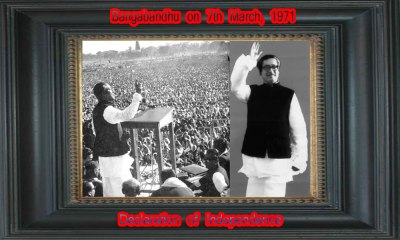
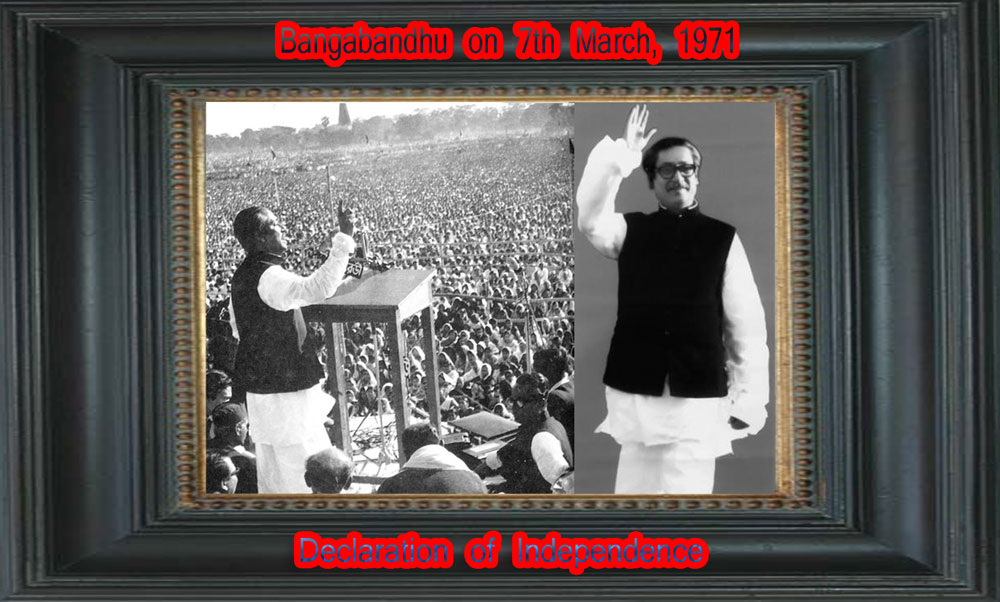
Historic Speech of Sheikh Mujibur Rahman on 7 March 1971 The situation reached a climax when in 1970 the Awami League, the largest East Pakistani political party, led by Sheikh Mujibur Rahman, won a landslide victory in the national elections. The party won 167 of the 169 seats allotted to East Pakistan, and thus a majority of the 313 seats in the National Assembly. This gave the Awami League the constitutional right to form a government. However, Zulfikar Ali Bhutto (a Sindhi), the leader of the Pakistan Peoples Party, refused to allow Rahman to become the Prime Minister of Pakistan. Instead, he proposed the idea of having two Prime Ministers, one for each wing. The proposal elicited outrage in the east wing, already chafing under the other constitutional innovation, the “one unit scheme”. Bhutto also refused to accept Rahmans Six Points. On 3 March 1971, the two leaders of the two wings along with the President General Yahya Khan met in Dhaka to decide the fate of the country. Talks failed. Sheikh Mujibur Rahman called for a nation-wide strike.
On 7 March 1971, Sheikh Mujibur Rahman delivered a speech at the Racecourse Ground (now called theSuhrawardy Udyan). In this speech he mentioned a further four-point condition to consider the National A
ssembly Meeting on 25 March:
1. The immediate lifting of martial law.2. Immediate withdrawal of all military personnel to their barracks.3. An inquiry into the loss of life.
4. Immediate transfer of power to the elected representative of the people before the assembly meeting 25 March.
He urged “his people” to turn every house into a fort of resistance. He closed his speech saying, “Our struggle is for our freedom. Our struggle is for our independence.” This speech is considered the main event that inspired the nation to fight for their independence. General Tikka Khan was flown in to Dhaka to become Governor of East Bengal. East-Pakistani judges, including Justice Siddique, refused to swear him in. Between 10 and 13 March, Pakistan International Airlines cancelled all their international routes to urgently fly “Government Passengers” to Dhaka. These “Government Passengers” were almost all Pakistani soldiers in civilian dress. MV Swat, a ship of the Pakistani Navy, carrying ammunition and soldiers, was harbored in Chittagong Port and the Bengali workers and sailors at the port refused to unload the ship. A unit of East Pakistan Rifles refused to obey commands to fire on Bengali demonstrators, beginning a mutiny of Bengali soldiers.
Bengalis were under-represented in the Pakistan military. Officers of Bengali origin in the different wings of the armed forces made up just 5% of overall force by 1965; of these, only a few were in command positions, with the majority in technical or administrative posts. West Pakistanis believed that Bengalis were not “martially inclined” unlike Pashtuns and Punjabis; the “martial races” notion was dismissed as ridiculous and humiliating by Bengalis. Moreover, despite huge defence spending, East Pakistan received none of the benefits, such as contracts, purchasing and military support jobs. The Indo-Pakistani War of 1965 over Kashmir also highlighted the sense of military insecurity among Bengalis as only an under-strength infantry division and 15 combat aircraft without tank support were in East Pakistan to thwart any Indian retaliation during the conflict.
Yahya’s call, Tikka Khan’s entry in the same day of 1971
Yahya’s call, Tikka Khan’s entry
Syed Badrul Ahsan
The day began in anticipation of what action Bangabandhu Sheikh Mujibur Rahman planned to take through his address at the Race Course public meeting the next day.
 All over East and West Pakistan, speculation was rife about a probable declaration of independence for Bangladesh by the Awami League chief, particularly against a background of the pressure he was under from his party and the students. Senior leaders of the party met at Bangabandhu’s Dhanmondi 32 residence to weigh the pros and cons of what he would be stating on March 7. Meanwhile, East Pakistan was being administered through a series of directives from the Awami League. These directives were made public on behalf of the party by the party general secretary general Tajuddin Ahmed. Employees of state and private organisations had by March 6 demonstrated complete allegiance to Sheikh Mujibur Rahman. The Dhaka station of Radio Pakistan had already been calling itself Dhaka Betar since March 5. It planned to broadcast live Bangabandhu’s address at the Race Course on March 7.
On the day, President Yahya Khan went on the national hook-up in Rawalpindi again, this time to announce a convening of the National Assembly in Dhaka on March 25. He and the rest of the regime were obviously concerned that unless such a move was made, the possibility of Mujib’s declaring independence for Bangladesh the next day would become all the greater. However, in the course of his address, General Yahya Khan sounded indignant and clearly seemed to be pinning the blame for the crisis on the Awami League. He noted that his efforts to call a round table conference on March 10 had not been accepted. And he made it clear, in what sounded like a threat, that as long as he was in charge, the Pakistan armed forces would do everything in their power to uphold the integrity and solidarity of Pakistan. The speech predictably did not go down well in East Pakistan. A significant development of the day was the appointment of Lt. General Tikka Khan,

infamous as the Butcher of Baluchistan for his murderous operations against Baluch tribals in the early 1960s, as governor of East Pakistan. He would also be functioning as martial law administrator, zone B. The move came following the departure, in quick succession, of Admiral S.M. Ahsan from the position of governor and Lt. Gen. Sahibzada Yaqub Khan from the position of martial law administrator, zone B. Tikka Khan’s efforts to be sworn in as governor would be thwarted by Chief Justice B.A. Siddiky’s refusal to administer the oath of office to him against the background of an intensifying nationalist movement in Bangladesh.
The investigation agency for International Crimes Tribunal has found former Jamaat-e-Islami ameer Ghulam Azam’s involvement in genocides, rapes and tortures on the people of Rajshahi during the Liberation War in 1971.
The crimes against humanity proliferated in Rajshahi after Ghulam Azam gave provocative speeches abusing religion, said investigators Additional Superintendent of Police (SP) Motiur Rahman and Inspector Shyamol Chowdury.
The two investigators are visiting the north-western city probing war crime charges against Ghulam Azam.
Talking exclusively to The Daily Star, the investigators said they found evidence and witnesses who testified that Ghulam Azam ordered various heinous measures during a meeting with the member of Central Peace committee in the town.
The investigators, however, refrained from disclosing the names of the witnesses. They said before going to Rajshahi from Kushtia, they took a copy of Jamaat mouthpiece the Dainik Sangram of July 19, 1971 from Bangla Academy Library in Dhaka. The issue has a report on Ghulam Azam’s Peace Committee meeting at the municipal hall in Rajshahi on July 8 with the committee’s Rajshahi chairman Ayen Uddin in the chair, which the witnesses also confirmed. “There is nothing to prove that the Hindus are friends of the Muslims. They have always been holding the Muslims as rivals and killing Muslims has been a daily incident in India even after the separation,” Dainik Sangram quoted Azam as saying. The report also quoted him as saying, “The Hindus created divisions among the Muslims raising the question of Bangalee and non-Bangalee. Foundation of a nation with Hindus and Muslims is not possible unless the Muslims are separated over the language issue.”
Investigators Rahman and Chowdhury came to Rajshahi Friday afternoon and separately talked with researchers, historians, freedom fighters, journalists and relatives of martyrs. On Saturday, they visited nine spots of genocides, mass grave and Pakistani torture camps in Rajshahi city, Mugroil and Sakoa in Mohonpur, and Thanapara and Sardah Police Academy in Charghat upazila. The team took photographs and footages of people identifying the mass graves and torture camps. In the morning, the team went to Mugroil, around 25km from Rajshahi city, where there is a shaheed minar (monument commemorating martyrs) with names of only 15 martyrs inscribed on it. The probe team talked to Basir Ali Sheikh and Hashim Uddin who lost their family members when the Pakistani occupation army captured 15 villagers on November 30, 1971 and shot them dead for helping freedom fighters. The army ravaged the village and torched every house, they said, adding that razakars (Pakistani collaborators) Daud Hossain, Nur-e Anwar, Motiur, Wahed and some others, who led the Pakistani army to the village, are still living freely in the village. From Mugroil the probe team visited a torture camp at Sakoa Madrasa where a number of freedom fighters and commoners were killed and tortured.
In Rajshahi, the investigators visited Babla Bon mass grave and torture camp near T Groyen of the Padma River. The Pakistani army with the help of their local collaborators picked up 17 people, including intellectuals and politicians, from their houses on the night of November 25, 1971, told freedom fighter Shahjahan Ali Borjahan in presence of journalists. The locals believe all the martyrs were buried alive as their bodies bore no bullet wounds, he added.
At Moslem Ali’s house near Boalia Police Station, Moslem’s son Salauddin Raju told reporters that after they had gone into hiding the occupation army took over their house to run a torture camp there. The investigators also visited Rajshahi University mass grave, Martyrs’ Memorial Archive and Shaheed Shamsuzzoha Hall where countless men, women and children suffered the atrocities of Pakistani army and their collaborators since April 1971. “Rajshahi apparently had been a bit different from other parts of the country, as the Pakistani collaborators here were so dominating that they opened torture camps at many places,” said SP Matiur Rahman.

 Why Bengali needs separation from Pakistan? In August 1947, the Partition of India gave birth to two new states named Pakistan and India. Areas containing the Muslim-majority became Pakistan while areas with Hindu majority states became India. The new nation of Pakistan included two geographically and culturally separate areas in the east and the west of India. The western zone was popularly (and for a period of time, also officially) termed West Pakistan and the eastern zone (modern-day Bangladesh) was initially termed East Bengal and later, East Pakistan. It was widely perceived that West Pakistan dominated politically and exploited the East economically, leading to many grievances.
 All over East and West Pakistan, speculation was rife about a probable declaration of independence for Bangladesh by the Awami League chief, particularly against a background of the pressure he was under from his party and the students. Senior leaders of the party met at Bangabandhu’s Dhanmondi 32 residence to weigh the pros and cons of what he would be stating on March 7. Meanwhile, East Pakistan was being administered through a series of directives from the Awami League. These directives were made public on behalf of the party by the party general secretary general Tajuddin Ahmed. Employees of state and private organisations had by March 6 demonstrated complete allegiance to Sheikh Mujibur Rahman. The Dhaka station of Radio Pakistan had already been calling itself Dhaka Betar since March 5. It planned to broadcast live Bangabandhu’s address at the Race Course on March 7.
 নষ্ট ভ্রষ্ট আমরা বাঙ্গালী জাতি
